

In 2020, Apple and several other parties collectively sued the Patent Office in a U.S. district court in California. They alleged that guidance* the Director gave the Patent Trial and Appeal Board—on how, while parallel patent litigation was pending, to exercise the Director’s discretion to deny inter partes review petitions—violated the Administrative Procedure Act (APA), particularly 5 U.S.C. § 706 (link). Apple Inc. v. Vidal, No. 20-CV-06128 (N.D. Cal. Mar. 31, 2024). Apple complained that the guidance led to too many discretionary denials of meritorious petitions and was otherwise also legally defective. When the lawsuit was filed, the Board made these institution decisions. Today, the Director does. The guidance is therefore largely meaningless unless the Director again delegates this task to the Board. Nonetheless, the Federal Circuit recently affirmed the district court’s rejection of Apple’s APA challenge. Apple Inc. v. Squires, Appeal 2024-1864 (Fed. Cir. Feb. 13, 2026).
The Federal Circuit concluded that the challenged guidance (also referred to as “instructions”) are exempt from the APA’s requirement for notice-and-comment rulemaking because they constitute a “general statement of policy” under 5 U.S.C. § 553(b) (link), rather than a substantive or legislative rule carrying the force and effect of law. The court said that the guidance is “best understood as merely advising the public prospectively of the manner in which the [Patent Office] proposes to exercise a discretionary power—here, through a delegatee’s initial decision that the Director is free to displace.” Apple, Slip Op. at 15 (citations omitted and cleaned up). Important to the court’s reasoning was Congress’s decision to vest institution authority in the Director’s discretion and to insulate non‑institution decisions from judicial review. As a matter of administrative law, the court’s decision seems appropriate, but as a matter of practical patent policy, it seems troubling.
The procedural posture of the case framed its outcome. In its 2023 decision, the Federal Circuit had already held that challenges to the substance of discretionary‑denial policy were unreviewable, leaving only the question whether the Director was required to proceed through notice-and-comment procedures. Apple Inc. v. Vidal, 63 F.4th 1 (Fed. Cir. 2023). On remand, the district court concluded that no such requirement existed, and the Federal Circuit agreed. Emphasizing that “[n]o law compels institution,” the court reiterated that “no petitioner has a right to such institution,” even when statutory thresholds are satisfied. Apple, Slip Op. at 4–5 (quoting Mylan Labs. Ltd. v. Janssen Pharmaceutica, N.V., 989 F.3d 1375, 1382 (Fed. Cir. 2021)); Cuozzo Speed Techs., LLC v. Lee, 579 U.S. 261, 273 (2016). Against that backdrop, the court concluded that the guidance altered no legal rights or obligations and emphasized that Apple has no right to an IPR. Id. at 16.
A key pillar of the court’s analysis was that the NHK‑Fintiv framework does not bind the Director himself. Although precedential for Board panels acting as his delegatees, the Court noted the guidance “does not even purport to bind the Director,” who retains authority to institute or deny review personally and to displace Board decisions at will. Apple, Slip Op. at 14–15. That retained flexibility, the Court explained, placed the guidance squarely within the APA’s policy-statement exemption in section 553(b). Doctrinally, this is consistent with Supreme Court and circuit precedent distinguishing binding norms from advisory pronouncements. See Chrysler Corp. v. Brown, 441 U.S. 281, 301 (1979). Practically, however, it endorses institution decisions—often dispositive of the Patent Office’s role in validity disputes—that are increasingly governed by guidance that is not anchored to any regulation that itself was the subject of notice-and-comment-rulemaking.
That practical consequence is particularly troubling when viewed against the economics of modern patent practice. A petitioner routinely invests between $200,000 and $250,000 in attorney and expert fees,** plus more than $50,000 in Patent Office filing fees just to file a petition. Yet a discretionary denial typically includes no reasoned explanation of the petition’s merits. And the Patent Office keeps the entire filing fee unless the petitioner asks for the partial refund prescribed by the regulations. The Federal Circuit emphasized that non‑institution leaves a challenger (petitioner) in the same legal position it occupied before the AIA, free to litigate validity in much more expensive district court proceedings or seek other fee-based Patent Office review procedures (e.g., reexamination). Apple, Slip Op. at 16–17. But that formal equivalence obscures the substantial waste of time and private and public resources—particularly the lost opportunity for the expert agency Congress entrusted with examining patent applications and issuing patents to assess whether it issued an unwarranted monopoly.
The concern is hardly hypothetical. Historically, the Patent Office instituted review on more than 60% of all filed IPR petitions—that is, the Office was persuaded that the petitioner had demonstrated a reasonable likelihood of prevailing on at least one challenged claim.
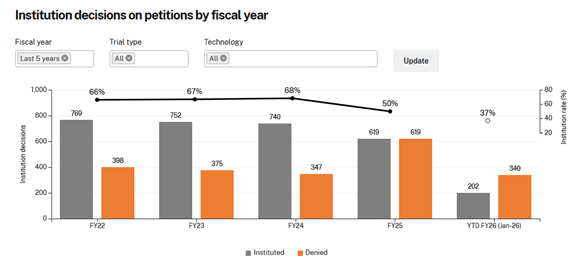
Patent Office statistics available at https://www.uspto.gov/dashboard/ptab/trials.html.
The change in the number of institution decisions from fiscal years 2024 to 2025 to 2026 is remarkable. It is unlikely that, almost overnight, a far smaller fraction (37%) of petitions now satisfies that standard. While the court noted that institution rates are not legally dispositive, Apple, Slip Op. at 15–16, the noticeable change between historical practice and present outcomes reinforces a perception that the Patent Office’s discretionary denials have largely displaced—rather than supplemented—the merits‑based review Congress designed. When that displacement occurs without transparent reasoning, it risks undermining the public’s confidence in the entire system of granting patents and later adjudicating infringement and validity.
If the Director’s concern is the burden that these petitions and AIA trials place on the Board (despite the high fees it collects for each petition), Congress has already provided the Director a sensible alternative that the court’s opinion leaves largely unexplored: Director‑ordered reexamination under 35 U.S.C. § 303(a) (link). The Supreme Court has recognized that Congress vested the Director with an inquisitorial role, authorizing him to reexamine patents on his own initiative and “at any time.” SAS Inst. Inc. v. Iancu, 584 U.S. 357, 370–71 (2018) (quoting section 303(a)). If a petition presents strong prior art but the Director believes that reassessment of patentability would be a poor use of the Board resources, nothing in the AIA prevents the Director from ordering reexamination on the petitioned grounds (without a separate reexamination request), to be handled by the experienced examiners of the Central Reexamination Unit.
Reexamination may suitably account for the strong public interest the Federal Circuit has repeatedly acknowledged: ensuring that patents the Office issues are valid over the best prior art, which is often first presented only after the patent issues. Apple, Slip Op. at 16–17. It may also satisfactorily serve parallel district‑court litigation. The Patent Office’s reexamination conducted without the procedural and estoppel complexities of inter partes review could inform the court’s analysis, narrow disputes, or even obviate litigation entirely if the Patent Office cancels claims. By contrast, discretionary denial coupled with silence on the merits deprives both the public and the courts of the Office’s technical judgment at precisely the moment it is most valuable.
Ultimately, the Federal Circuit’s decision endorses the discretionary‑denial regime as a matter of administrative law, while leaving for Congress whether that regime reflects a sensible allocation of the Patent Office’s responsibility. The Court made clear that any recalibration must come not from the courts, but rather from the Director through formal rulemaking or from Congress. Until that recalibration (if it ever comes), prospective petitioners must seriously consider whether it is worth investing resources in seeking this type of Patent Office review. The Director may deny even strong challenges without meaningful explanation and without further judicial review. See, e.g., In re Intel Corp., Case 2026-113, Slip Op. (Feb. 24, 2026) (denying a writ of mandamus where the Director refused to institute review on Intel’s grantable IPR petition and recommended Intel file a reexamination request instead). Administrative priorities and other factors unrelated to the merits may therefore shape more outcomes. Whether that is a feature or a flaw of the AIA remains an open question.
* The Director offered this guidance through a pair of precedential decisions the Board was obligated to follow: NHK Spring Co. v. Intri-Plex Techs., Inc., IPR2018-00752, 2018 WL 4373643 (P.T.A.B. Sept. 12, 2018) (made precedential on May 7, 2019) (NHK); Apple Inc. v. Fintiv, Inc.v, IPR2020-00019, 2020 WL 2126495 (P.T.A.B. Mar. 20, 2020) (modifying NHK, made precedential on May 5, 2020) (Fintiv). It is often referred to as the “NHK‑Fintiv framework.”
** Report of the Economic Survey 2025, I-177 (American Intellectual Property Law Association 2025), available via www.aipla.org.